What Great Films Understood About Sunglasses
There's a shortcut filmmakers have been using for decades. Put the right pair of sunglasses on a character and you've already told the audience something, before the dialogue, before the plot, sometimes before the actor has even moved. It's remarkably efficient storytelling for something that costs twenty bucks.
Take Maverick in Top Gun. The aviator frames weren't a costume choice made in isolation, they were loaded with history before the film started. Military, functional, earned. Putting them on Cruise communicated confidence without the character having to perform it. The glasses did the work. That's a very different thing from what happened with Neo in The Matrix, where the narrow black frames were chosen to feel slightly wrong, minimal to the point of inhuman, sitting just outside normal, which was exactly where the character needed to be.
Both used eyewear to tell you who someone was. Both landed completely differently.
.webp "Sunglasses in Movies blog by iPOP")
Audrey Hepburn in Breakfast at Tiffany's is probably the most referenced moment in eyewear history. It's easy to oversimplify it, iconic actress, iconic film, of course it became iconic. But watch the scene again and there's something more practical going on. Holly Golightly uses those oversized frames the way a lot of people use sunglasses in real life: as a way to move through the world with a bit of distance from it. The glasses aren't decoration. They're armour. That's why the image has lasted sixty years.
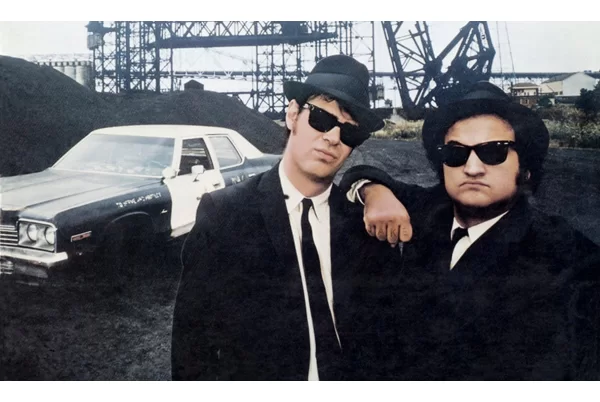
The Wayfarer got two defining film moments inside a few years of each other in the early eighties. Risky Business used them as a signal of teenage confidence, slightly reckless, not quite adult, figuring it out. The Blues Brothers used the exact same frame for something completely different: deadpan, theatrical, costume-as-joke. One frame, two completely different registers. That versatility is part of why the shape has never fully left.
Men in Black did something more interesting than people give it credit for. The matching suits and shades weren't about individual cool, they were about erasing personality in service of institution. Smith and Jones wearing identical frames made them interchangeable, which was the point. The glasses hid reactions to alien chaos in the story, but on screen they turned two very different actors into a single visual idea. Three sequels later, the image still holds.
.webp "Sunglasses in Movies from iPOP")
Bond's eyewear is worth noting precisely because it never calls attention to itself. Classic frames, nothing flashy, always right for the setting. That restraint is deliberate, the glasses reinforce composure rather than announcing it. Compare that to Scarface, which used bold frames as pure declaration. Status, ambition, power before the dialogue even starts. Both approaches work. They're just saying very different things.
Steve McQueen is the hardest one to pin down because his relationship with sunglasses, on screen and off, never looked curated. Fast cars, open roads, nothing trying too hard. The frames just seemed to belong on his face, which is the highest compliment you can pay eyewear and almost impossible to manufacture deliberately.
The aviators in The Big Lebowski are worth contrasting with Top Gun's. Same basic frame, entirely different meaning. Where Maverick's communicated ambition and precision, The Dude's communicated the opposite, total unbothered ease, no agenda, nowhere to be. Context changes everything. The Terminator's wraparounds worked on a third axis entirely: not cool, not casual, just machine-cold. Hiding the eyes there wasn't a style move, it was a threat.
Brad Pitt's performance frames in the F1 film are more recent but follow the same logic, wraparound shapes that communicate precision and belonging in a high-speed technical world. They don't need to be showy. The environment makes the argument for them.
What runs through all of it is that the best eyewear in film is never really about the eyewear. It's doing a job, compressing character, signalling attitude, telling the audience how to read someone before the scene has properly started. Off screen the job is simpler: cut the glare, block the UV, make it through a NZ summer without squinting. iPOP Eyewear operates in that same overlap between looking right and working properly, the film set just makes it more obvious.
Latest Blogs